

Guide · Lease math
Load factor explained
Two offices with the same desks and the same rent per foot can cost thousands a year apart. Load factor is usually why. Rentable area equals usable area times one plus the load factor. A 2,000 sq ft usable space with a 15% load factor is billed as 2,300 sq ft.


General information, not tax or legal advice. The numbers here are illustrative. Talk to your lawyer and accountant before you act on them.
Usable vs rentable
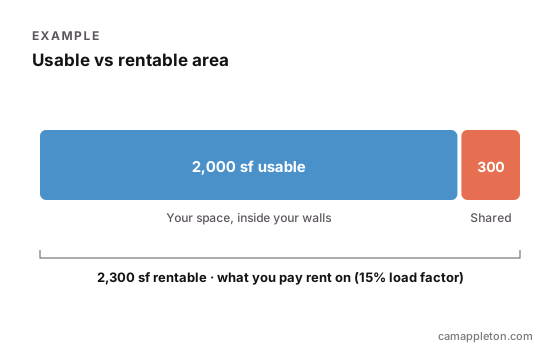
Usable area is the space you actually occupy: inside your walls. Rentable area is usable area plus your share of the building’s common areas, like lobbies, corridors, washrooms and mechanical rooms. Rent and additional rent are charged on rentable area.
The formula
Load factor = (rentable area − usable area) ÷ usable area
And the other way round: rentable area = usable area × (1 + load factor)
Example: 2,000 sf usable with a 15% load factor is 2,000 × 1.15 = 2,300 sf rentable. You’re paying for 300 sf of hallway, washroom and lobby. Some people quote the same thing as a ratio (1.15) or call it the add-on factor.
Why it matters
| Measure | Building A | Building B |
|---|---|---|
| Usable area | 2,000 sf | 2,000 sf |
| Load factor | 15% | 10% |
| Rentable area | 2,300 sf | 2,200 sf |
| Gross rate (base + additional) | $46 /sf | $46 /sf |
| Annual cost before GST | $105,800 | $101,200 |
Same space to work in, same rate, and Building A costs $4,600 more a year, or $23,000 over a five-year lease. When you compare buildings, compare cost per usable foot, or just compare total dollars.
Things to check
- How the space was measured, and which standard was used. Many buildings use a BOMA standard, the measuring rules published by the Building Owners and Managers Association. It sets out what counts as your usable area and how shared space like lobbies, hallways and washrooms gets split among tenants. Ask which version the landlord used, because different versions can give the same space a different rentable area.
- Whether the lease lets the landlord remeasure and change your area later.
- Whether a full-floor tenant gets a lower load factor than a multi-tenant floor. Often they do.
- On retail and industrial, load factors are often small or zero, but check anyway.
Try your own numbers in the lease calculator.
Questions people ask
What is a typical load factor for office space?
It varies by building and floor. Multi-tenant floors usually carry more load than full floors because shared corridors are counted. Ask for the load factor on every space you compare rather than assuming.
How do I calculate rentable square feet?
Multiply usable square feet by one plus the load factor. 2,000 usable sf at a 15% load factor is 2,300 rentable sf.
Go deeper
If you’re looking for more details
Worked example
You need 2,000 usable square feet. Building A has a 12% load factor, Building B has 18%.
- A: 2,000 × 1.12 = 2,240 rentable square feet
- B: 2,000 × 1.18 = 2,360 rentable square feet
At $50 per square foot all in, B costs $6,000 more a year for the same usable space.
Mistakes to avoid
- Comparing rent per square foot without checking the load factor.
- Assuming the measured area on the listing is right. Ask how it was measured and when.
Run the numbers
Search
Not quite your situation? Search
Next step
Compare two buildings on real cost.
Send me both listings. I can put them side by side on real cost.