

Guide · Lease math
Net effective rent: how to compare lease offers fairly
The offer with the lowest rent isn’t always the cheapest. Net effective rent folds in free rent and allowances so you can compare offers on one number. It equals the total rent you pay, minus incentives, divided by the years in the term.


General information, not tax or legal advice. The numbers here are illustrative. Talk to your lawyer and accountant before you act on them.
The idea
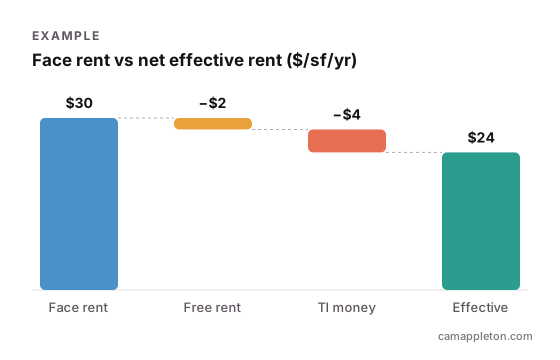
Net effective rent is the average base rent you really pay per square foot per year, after you subtract the value of the landlord’s incentives over the term.
Net effective rent = (total base rent over the term − free rent − TI allowance) ÷ (rentable area × years)
Two offers for the same 2,300 sf space, five years
| Item | Offer A | Offer B |
|---|---|---|
| Base rent | $30 /sf | $27 /sf |
| Free rent | 4 months | none |
| TI allowance | $20 /sf | none |
| Total base rent | $345,000 | $310,500 |
| Less free rent | −$23,000 | $0 |
| Less TI allowance | −$46,000 | $0 |
| Net cost | $276,000 | $310,500 |
| Net effective rent | $24.00 /sf | $27.00 /sf |
Offer A looks $3 more expensive and is actually $3 a foot cheaper, about $34,500 over the term, provided you were going to spend that TI money on the build-out anyway.
Why landlords like Offer A
Their building is valued on the rent roll, so they’d rather keep the face rent high and give you incentives up front. How landlords think explains the math.
Fine print
- This simple version ignores the time value of money. A more precise version discounts each year’s payments, which favours incentives you get early.
- Additional rent usually still applies during free base rent months. Check.
- A TI allowance is only worth its full value if you’d spend it anyway, and if it’s paid on time. Read how and when it’s paid.
The lease calculator works out net effective rent for you.
Questions people ask
Does free rent include additional rent?
Not always. Many leases give free base rent while you still pay additional rent (taxes, insurance and operating costs). The wording decides, so check it before you sign.
Go deeper
If you’re looking for more details
Step by step
- Add up all the base rent over the term.
- Subtract free rent.
- Subtract the tenant improvement allowance, if it’s paid to you.
- Divide by the area and the number of years.
The result is the average rent per square foot per year that you actually pay.
What it leaves out
It doesn’t count additional rent, moving costs, or the time value of money. Use it to compare offers, then check the monthly cash flow separately.
Search
Not quite your situation? Search
Next step
Compare offers on what they really cost.
Send them over. I can work out which one is really cheaper.